Victoria Thompson
 Victoria
Thompson - author of approximately twenty romance novels - entered the mystery
field with Murder on Astor Place,
which appeared in 1999. It introduced Sarah Brandt and Frank Malloy, who would
be the protagonists of - to date - all of her subsequent novels. Brandt is a
widow working as a professional midwife working in turn of the century New York
City. Her parents are rich but they are estranged. Sergeant Frank Malloy
is a police investigator who has accepted the corruption of that organization
and when a young girl named Alicia Van Damm is found murdered in a rooming
house, he sees no way that solving the crime can advance his career. Despite
some initial antagonism, he convinces Brandt to examine the dead girl's
belongings and she is shocked to realize the victim was the younger sister of a
wealthy woman she once knew quite well. She also forms the opinion that the girl
was pregnant after an abortionist's tool turns up at the murder scene, and later
learns that another tenant, a man named Fisher, moved out of the boarding house
quietly that same night. Malloy has good reason to dislike Brandt; his wife died
while being attended by a midwife and he blames the woman for her death.
Victoria
Thompson - author of approximately twenty romance novels - entered the mystery
field with Murder on Astor Place,
which appeared in 1999. It introduced Sarah Brandt and Frank Malloy, who would
be the protagonists of - to date - all of her subsequent novels. Brandt is a
widow working as a professional midwife working in turn of the century New York
City. Her parents are rich but they are estranged. Sergeant Frank Malloy
is a police investigator who has accepted the corruption of that organization
and when a young girl named Alicia Van Damm is found murdered in a rooming
house, he sees no way that solving the crime can advance his career. Despite
some initial antagonism, he convinces Brandt to examine the dead girl's
belongings and she is shocked to realize the victim was the younger sister of a
wealthy woman she once knew quite well. She also forms the opinion that the girl
was pregnant after an abortionist's tool turns up at the murder scene, and later
learns that another tenant, a man named Fisher, moved out of the boarding house
quietly that same night. Malloy has good reason to dislike Brandt; his wife died
while being attended by a midwife and he blames the woman for her death.
Malloy notifies the Van Damm family whose reactions are strange. The mother
seems mentally fragile and out of touch. Malloy is convinced that the father and
older sister both knew about the pregnancy, knew where Alicia was, believe that
she was in fact murdered, but don't want to be involved. They even send the
butler to identify the body. Brandt visits the family and is shocked by how
callous they are, more concerned about a scandal than the identity of Alicia's
killer. She passes on her meager store of information to Malloy, who doesn't
seem particularly interested. Brandt has some contacts in the underworld who
wouldn't speak to Malloy so their investigations proceed separately at first.
Brandt learns that Fisher is a false name and that the missing tenant is
actually a private detective who works for a shady lawyer. Brandt reconciles
with her mother from whom she hears the rumor that Alicia was to be married to
the shady lawyer, Mattingly, who applies pressure to have Malloy taken off the
case. Understandably annoyed, he decides to encourage Brandt to pursue the
investigation on her own. They track down an abortionist who might have been
present shortly before the murder, but she is herself strangled before they can
question her, presumably because she could identify the killer, who accompanied
her to the boarding house.
The overwhelming theme in this - even stronger than the murder plot - is the
inhumanity of the class system and the almost insane horror of scandal among the
upper class. Brandt's discovery that Alicia could not have been the daughter of
her supposed mother - who tells her confidentially that she has not had sexual
relations since long before Alica was born - is potentially an earth shaking
scandal. Mallow discovers that the servant who helped Alicia slip away has been
murdered, although it is arranged to look like suicide. He also finds the dead
girl's diary and discovers what we already suspect - that Alicia's father killed
her because, in part, she was his illicit child by his own daughter, her older
sister. I confess that I was predisposed to find fault with the book because
Thompson's previous work had all been in the romance genre, but this is not only
a decent police procedural but a pretty effective indictment of the kind of
snobbery that was common at the time and not all that uncommon even today. I
also expected this to be a typical cozy, in which the protagonist solves the
crime because his/her investigation provokes the killer into revealing himself,
but in fact it is a logical deduction based on what they have methodically
learned. There's a rather melodramatic climax but all in all this is a very good
detective story which avoids cheating and delivers what it promises.
 The
second book in the series was Murder on
St. Mark's Place (2000).Although the two protagonists parted on better
terms than when they met, neither expects to see the other again. That changes
when Brandt learns that one of her clients has just lost a teenaged sister,
beaten to death and left in an alley. She prevails upon Malloy to find out how
the investigation is proceeding, meanwhile discovering that the latter's
supposedly retarded son is actually only deaf. She also learns almost
inadvertently that three other young women have recently died under very similar
circumstances. Malloy reluctantly accepts her theory that one man may well be
responsible for all three murders and they kick off their investigation with a
trip to Coney Island. Separately and together they begin to talk to friends and
families of the victims, but are hampered by the fact that most of the men who
pick up young girls at dances use false names. One of them in fact is someone
from a wealthy family whom Brandt knows, much to his embarrassment. The romantic
subplot is minimal but the growing reconciliation between Brandt and her family,
and Malloy's attempts to find suitable training for his deaf son, are both
handled both intelligently and entertainingly, the latter involving the
disagreement about whether lip reading or signing is the most advantageous
strategy. The investigation draws closer and it's quite reasonably described,
although the identity of the killer is rather painfully telegraphed midway
through the story. There is a twist at the end, but it is also telegraphed and
loses its effect. Although in many ways better written than the first, it is a
far less satisfying mystery story.
The
second book in the series was Murder on
St. Mark's Place (2000).Although the two protagonists parted on better
terms than when they met, neither expects to see the other again. That changes
when Brandt learns that one of her clients has just lost a teenaged sister,
beaten to death and left in an alley. She prevails upon Malloy to find out how
the investigation is proceeding, meanwhile discovering that the latter's
supposedly retarded son is actually only deaf. She also learns almost
inadvertently that three other young women have recently died under very similar
circumstances. Malloy reluctantly accepts her theory that one man may well be
responsible for all three murders and they kick off their investigation with a
trip to Coney Island. Separately and together they begin to talk to friends and
families of the victims, but are hampered by the fact that most of the men who
pick up young girls at dances use false names. One of them in fact is someone
from a wealthy family whom Brandt knows, much to his embarrassment. The romantic
subplot is minimal but the growing reconciliation between Brandt and her family,
and Malloy's attempts to find suitable training for his deaf son, are both
handled both intelligently and entertainingly, the latter involving the
disagreement about whether lip reading or signing is the most advantageous
strategy. The investigation draws closer and it's quite reasonably described,
although the identity of the killer is rather painfully telegraphed midway
through the story. There is a twist at the end, but it is also telegraphed and
loses its effect. Although in many ways better written than the first, it is a
far less satisfying mystery story.
 Murder
on Gramercy Park (2001) opens with the murder - designed badly to look
like suicide - of a semi-quack doctor named Blackwell. The body is discovered by
his pregnant wife, which causes Malloy to call in Brandt for medical reasons. He
interviews the dead man's assistant, Potter, who tells him that Blackwell has a
son from his first marriage, and that he was never divorced and was
therefore a bigamist. The wife was also secretly addicted to morphine. The son,
Calvin, shows up clearly unaware that his father is dead and tells Malloy that
someone anonymously sent a poster with his father's face, a train ticket, and
some money, obviously intent upon embarrassing the doctor. Another potential
suspect is the widow's father, who appears not to have known that his son was a
bigamist. There are also rumors that the deceased had been guilty of adultery
with some of his female patients, and at the funeral some of the husbands seem
more annoyed than sorrowful. The father-in-law seems an even more likely
suspect when Calvin tells Malloy that he told the man the whole story a few days
before the murder. But the man is rich and powerful and Malloy doesn't dare even
question him without a much better case beforehand.
Murder
on Gramercy Park (2001) opens with the murder - designed badly to look
like suicide - of a semi-quack doctor named Blackwell. The body is discovered by
his pregnant wife, which causes Malloy to call in Brandt for medical reasons. He
interviews the dead man's assistant, Potter, who tells him that Blackwell has a
son from his first marriage, and that he was never divorced and was
therefore a bigamist. The wife was also secretly addicted to morphine. The son,
Calvin, shows up clearly unaware that his father is dead and tells Malloy that
someone anonymously sent a poster with his father's face, a train ticket, and
some money, obviously intent upon embarrassing the doctor. Another potential
suspect is the widow's father, who appears not to have known that his son was a
bigamist. There are also rumors that the deceased had been guilty of adultery
with some of his female patients, and at the funeral some of the husbands seem
more annoyed than sorrowful. The father-in-law seems an even more likely
suspect when Calvin tells Malloy that he told the man the whole story a few days
before the murder. But the man is rich and powerful and Malloy doesn't dare even
question him without a much better case beforehand.
Brandt learns that the widow was eloping with an unnamed school teacher when she
had the accident which led to her meeting her future husband. This seems even
more significant paired with the observation that the baby has red hair, unlike
either of the parents. The former lover - who also has red hair - reappears
somewhat surreptitiously although Brandt fortuitously visits at just the right
moment to meet him. Then the son is murdered in his apartment, apparently a
suicide and leaving a note confessing to having murdered his father. This is
obviously a second attempt at subterfuge, and a more skillful one. When the
lover is also attacked, although he survives, Brandt is watching over him when
she finds something dropped by the killer, and then subdues the killer who
returns in an attempt to retrieve it. There's some clumsiness in this one. The
dropped clue is rather convenient and the fact that Malloy and Brandt repeatedly
tell us that the guilty man is the only one not a suspect telegraphs his guilt,
although only for one of the two murders.
 Murder
on Washington Square (2002) opens with Brandt agreeing to see a
neighbor's mistress. The woman, Anna Blake, is supposedly an innocent who became
pregnant but it's rather obviously a confidence scheme in which her landlady and
others are involved. The man, Nelson Ellsworth, is clearly the real innocent,
who has already been fleeced of a not inconsiderable sum of money. When Blake is
found stabbed to death, Ellsworth is immediately arrested. The plot thickens
quickly. The landlord, Walcott, and his wife are decidedly uncooperative and
have contradictory information about Blake's history. Their other boarder,
Catherine Porter, is mysteriously silent and reluctant to admit she was once a
stage actress, and currently has multiple gentlemen friends. Another man,
Giddings, shows up claiming to be Blake's fiancé, and he claims to be unaware of
the murder. The dead woman was killed in the middle of the night and she went
out without taking her purse, both of which facts are puzzling. The landlord
seems to have a great deal of money for someone who is compelled to take in
boarders to make ends meet. Other interesting information includes the
disappearance of the man who lived there before the Walcotts arrived and the
maid's complaint that it smells like something died in the basement.
Murder
on Washington Square (2002) opens with Brandt agreeing to see a
neighbor's mistress. The woman, Anna Blake, is supposedly an innocent who became
pregnant but it's rather obviously a confidence scheme in which her landlady and
others are involved. The man, Nelson Ellsworth, is clearly the real innocent,
who has already been fleeced of a not inconsiderable sum of money. When Blake is
found stabbed to death, Ellsworth is immediately arrested. The plot thickens
quickly. The landlord, Walcott, and his wife are decidedly uncooperative and
have contradictory information about Blake's history. Their other boarder,
Catherine Porter, is mysteriously silent and reluctant to admit she was once a
stage actress, and currently has multiple gentlemen friends. Another man,
Giddings, shows up claiming to be Blake's fiancé, and he claims to be unaware of
the murder. The dead woman was killed in the middle of the night and she went
out without taking her purse, both of which facts are puzzling. The landlord
seems to have a great deal of money for someone who is compelled to take in
boarders to make ends meet. Other interesting information includes the
disappearance of the man who lived there before the Walcotts arrived and the
maid's complaint that it smells like something died in the basement.
Giddings, his wife, and his teenaged son all make it onto the list of
suspects. The coroner reveals that Blake was not pregnant, which comes as no
surprise, and that she was not killed where her body was found, which is
suggestive. A reporter following the case is lured into an alley by a woman and
stabbed, but he cannot identify her. Ellsworth is then accused of embezzling
money from the bank where he works, but there is good reason to believe that the
bank manager is lying about the missing money, which adds him to the list of
suspects. The reader is probably far ahead of the two detectives by now because
Thompson telegraphs things so many times that it draws our attention to the
smell from the basement, and it's been obvious all along that the Walcotts are
running a clever prostitution/blackmail ring. The fact that the murdered wo,am
was not wearing a coat also suggests that she was murdered indoors, presumably
at the boarding house. The hospitalized reporter is nearly murdered in his bed
by a veiled woman, which strongly suggests Mrs. Walcott is responsible.
Giddings' wife confesses to the murder, but clearly only to protect her son, who
has become Malloy's prime suspect. The closing chapters are unfortunately
terrible. Brandt is so obtuse all of a sudden that she goes alone to the Walcott
house and accepts tea that tastes very much like the poison that was used to try
to kill the reporter, even after Mrs. Walcott very plainly asks if anyone knows
where she is. This is so completely out of character that it ruins the story,
and the ploy of solving the crime by inadvertently stumbling into the murderer's
hands is far inferior to the solution in the first three books, despite a rather
clever hidden identity device that I didn't see coming.
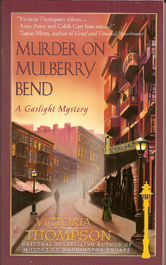 Murder
on Mulberry Bend 2003) takes a while to get going because we are first
brought up to date on the interactions among the recurring characters and the
operation to repair Malloy's son's foot. A switch of focus to background plots
often dilutes the quality of a mystery series, for example, the later China
Bayles novels by Susan Wittig Alpert. Brandt donates some old clothing to a
mission run by a bigoted woman and the clothing turns up on the body of a young
girl found dead near City Hall. She was stabbed with a stiletto and Malloy
suspects that the Black Hand, a secretive criminal organization, is involved.
The dead girl's mother is uncooperative; the girl was the result of a rape, as
is her brother. The father is more grief stricken but uncommunicative. Malloy
gets the name of the man who seduced and beat her a year or two earlier and the
name of a pimp who enlisted her for some time. The former seems to be genuinely
surprised about the murder and the pimp proves to be elusive. Brandt, naturally,
tries some investigating of her own but initially seems to be doing more harm
than good. And when Malloy finally runs down the pimp, he is convinced the man
had nothing to do with it, nor did the Black Hand. Since the author has once
again telegraphed the information that the mission's stiffnecked manager is
involved, this comes as no surprise.
Murder
on Mulberry Bend 2003) takes a while to get going because we are first
brought up to date on the interactions among the recurring characters and the
operation to repair Malloy's son's foot. A switch of focus to background plots
often dilutes the quality of a mystery series, for example, the later China
Bayles novels by Susan Wittig Alpert. Brandt donates some old clothing to a
mission run by a bigoted woman and the clothing turns up on the body of a young
girl found dead near City Hall. She was stabbed with a stiletto and Malloy
suspects that the Black Hand, a secretive criminal organization, is involved.
The dead girl's mother is uncooperative; the girl was the result of a rape, as
is her brother. The father is more grief stricken but uncommunicative. Malloy
gets the name of the man who seduced and beat her a year or two earlier and the
name of a pimp who enlisted her for some time. The former seems to be genuinely
surprised about the murder and the pimp proves to be elusive. Brandt, naturally,
tries some investigating of her own but initially seems to be doing more harm
than good. And when Malloy finally runs down the pimp, he is convinced the man
had nothing to do with it, nor did the Black Hand. Since the author has once
again telegraphed the information that the mission's stiffnecked manager is
involved, this comes as no surprise.
Feeling irrationally guilty, Brandt volunteers to teach hygiene at the
mission, where she discovers that there is intense rivalry among the girls for
the manager's approval. Malloy is ordered off the case, so he spends some time
on his unofficial investigation of the the death of Brandt's husband three years
earlier. Unfortunately, what he learns suggests that Brandt's father might be
the killer. Despite having indicated her understanding that the case was closed,
Brandt continues to ask questions at the mission. She meets a local priest who
hints that some of the girls who go to the mission disappear under mysterious
circumstances. She also stumbles upon the murder weapon, a hatpin, which
strongly suggests that the murderer was a woman. There's a clumsy bit of
misdirection suggesting the dead girl's mother committed the crime, but it's
pretty obvious that the mission manager is the culprit and it has been from very
early in the story. The ending is rather weak as well. Brandt doesn't figure out
who is responsible until she is attacked herself. More historical adventure than
mystery.
 Next
was Murder on Marble Row (2004).
Businessman Gregory Van Dyke is killed by a bomb planted in his office. The
consensus is that it was anarchists, but Malloy is unconvinced. The dead man
leaves behind his second wife, a much younger woman, his spinster daughter, and
two sons, the older of whom is an avowed anarchist and the younger a minor clerk
working in his father's business. It appears that Van Dyke was not on good terms
with either of his sons. There are also rumors that the victim had caught his
business partner doing something illegal. Brandt quickly determines that
the daughter is pregnant despite her claim that she has no male friends, and
Malloy learns that Van Dyke had planned to present an expensive bottle of brandy
to his partner on the day when he was killed. The anarchist son, as it happens,
is supporting his entire group of friends so they also had a motive for wanting
his father dead, on the assumption that he would inherit a lot of money which he
would share with them. One of the group, Katya, is also his common law wife and
is carrying his child.
Next
was Murder on Marble Row (2004).
Businessman Gregory Van Dyke is killed by a bomb planted in his office. The
consensus is that it was anarchists, but Malloy is unconvinced. The dead man
leaves behind his second wife, a much younger woman, his spinster daughter, and
two sons, the older of whom is an avowed anarchist and the younger a minor clerk
working in his father's business. It appears that Van Dyke was not on good terms
with either of his sons. There are also rumors that the victim had caught his
business partner doing something illegal. Brandt quickly determines that
the daughter is pregnant despite her claim that she has no male friends, and
Malloy learns that Van Dyke had planned to present an expensive bottle of brandy
to his partner on the day when he was killed. The anarchist son, as it happens,
is supporting his entire group of friends so they also had a motive for wanting
his father dead, on the assumption that he would inherit a lot of money which he
would share with them. One of the group, Katya, is also his common law wife and
is carrying his child.
Malloy puts the older son under house arrest but he escapes. He also finds
evidence suggesting that the bomb was triggered from outside the building rather
than wired to explode in response to some action by the victim or by means of a
timer. Brandt, meanwhile, hears rumors that the widow may have had a clandestine
affair and she notes a rather excess of affection between her and the younger
son. Malloy discovers the identity of the daughter's lover - the dead man's
secretary, who was injured by the blast, and also that a member of the anarchist
group was the mistress of a man presently in prison for attempted murder,
although the group claims to have abandoned murder as a tactic. The anarchist
movement is clearly a red herring but it's a well developed one. The will, only
a month old, leaves everything to the anarchist son, cutting off the wife and
his two siblings almost entirely. The reader will probably by now have picked
the secretary, Reed, as the prime suspect since he's known to be clever, had
been ordered not to see the dead man's daughter again, and certain oddities
about the bomb suggest it might have been a booby trap instead of remotely
controlled after all. When the author makes a point of telling us that he knows
a lot about electrical wiring, it seems quite ovbvious. Which of course is
indicative of a trap for the unwary reader.
Malloy has dismissed the partner after a quite convincing description of his
affair with the widow. He claims that it was a one time deal meant to infuriate
her husband, but Brandt surprises them together in compromising circumstances.
When Malloy decides to confront him, he finds the man dead - apparently having
hanged himself, although that doesn't seem to fit his character. This one was
hard to figure out because there are actually two different killers. Although
it's fairly easy to guess one of them, it doesn't seem logical given the other
death, until you know he committed only one of the crimes. The bomb was in fact
part of a fairly clever and somewhat elaborate plot, but plausible enough to be
credible. This was a decided improvement over the previous two books.
 Murder
on Lenox Hill (2005) opens with Brandt effectively adopting the young
mute girl she found in a home two books earlier. There's also some more byplay
between Malloy and Brandt's father, Felix Decker, about the murder of her
husband a few years earlier. Malloy has good reason to believe that Decker was
himself the killer. Brandt is hired by a family whose mentally challenged
daughter has become pregnant. It's rather a mystery because she supposedly never
is alone with males other than her father and seems to have no recollection of
having had sex. That investigation seems to be leading nowhere but Brandt
persists, while Malloy discovers that the evidence Decker provided suggesting
that her husband was leading a double life is questionable at best. Suspicion
for the rape briefly lingers on the local minister, but it is painfully obvious
that he is gay and therefore innocent. When the congregation finds out, they
confront him during a service. When he drinks from the communion cup, which no
one else has touched, he falls dead, poisoned. To his dismay, Malloy has four
different people confess to the murder in short order, although none of them
knows how it was done and each is obviously attempting to protect someone else.
The closing chapters of this are quite good, although I guessed what had really
happened. The back stories are handled well this time - advancing without being
too intrusive. This is one of Thompson's best.
Murder
on Lenox Hill (2005) opens with Brandt effectively adopting the young
mute girl she found in a home two books earlier. There's also some more byplay
between Malloy and Brandt's father, Felix Decker, about the murder of her
husband a few years earlier. Malloy has good reason to believe that Decker was
himself the killer. Brandt is hired by a family whose mentally challenged
daughter has become pregnant. It's rather a mystery because she supposedly never
is alone with males other than her father and seems to have no recollection of
having had sex. That investigation seems to be leading nowhere but Brandt
persists, while Malloy discovers that the evidence Decker provided suggesting
that her husband was leading a double life is questionable at best. Suspicion
for the rape briefly lingers on the local minister, but it is painfully obvious
that he is gay and therefore innocent. When the congregation finds out, they
confront him during a service. When he drinks from the communion cup, which no
one else has touched, he falls dead, poisoned. To his dismay, Malloy has four
different people confess to the murder in short order, although none of them
knows how it was done and each is obviously attempting to protect someone else.
The closing chapters of this are quite good, although I guessed what had really
happened. The back stories are handled well this time - advancing without being
too intrusive. This is one of Thompson's best.
 Murder
in Little Italy (2006) opens with Brandt delivering a baby to a
prosperous Italian family with connections to organized crime. It is obvious to
all concerned that the baby is too advanced to have been fathered by her husband
and the young Irish mother is ordered to leave as soon as she is able to travel.
Unfortunately, she is smothered to death that very night and a melodramatic
tabloid story stirs up trouble between the two ethnic communities which forces
the police to investigate thoroughly, in this case assigning Malloy. There are
tensions within the Italian family. The youngest daughter is a spoiled brat who
hated the dead girl. Her not very bright husband seems to be a cipher. The wife
of another married son, Maria, who is apparently barren, insists upon keeping
the baby with the support not of her husband but of the third brother. The
matriarch of the family expresses disdain but softens even though she assumes it
is not her grandchild after all. Her brother in law is the head of the dreaded
Black Hand, however, and he wanted the baby and its mother killed. Added to the
mix is the dead girl's mother, who enjoys histrionics but probably doesn't care
about her daughter, and the dead girl's former employer, who may be the actual
father. Although as always the story is very entertaining, the real identity of
the baby's father is evident very early. The fact that the unattached brother is
so solicitous, and the dead girl's conviction that she knows something that will
keep her in the family, make it pretty obviously that they are secretly a
couple.
Murder
in Little Italy (2006) opens with Brandt delivering a baby to a
prosperous Italian family with connections to organized crime. It is obvious to
all concerned that the baby is too advanced to have been fathered by her husband
and the young Irish mother is ordered to leave as soon as she is able to travel.
Unfortunately, she is smothered to death that very night and a melodramatic
tabloid story stirs up trouble between the two ethnic communities which forces
the police to investigate thoroughly, in this case assigning Malloy. There are
tensions within the Italian family. The youngest daughter is a spoiled brat who
hated the dead girl. Her not very bright husband seems to be a cipher. The wife
of another married son, Maria, who is apparently barren, insists upon keeping
the baby with the support not of her husband but of the third brother. The
matriarch of the family expresses disdain but softens even though she assumes it
is not her grandchild after all. Her brother in law is the head of the dreaded
Black Hand, however, and he wanted the baby and its mother killed. Added to the
mix is the dead girl's mother, who enjoys histrionics but probably doesn't care
about her daughter, and the dead girl's former employer, who may be the actual
father. Although as always the story is very entertaining, the real identity of
the baby's father is evident very early. The fact that the unattached brother is
so solicitous, and the dead girl's conviction that she knows something that will
keep her in the family, make it pretty obviously that they are secretly a
couple.
Then someone murders the dead girl's mother and suspicion quickly shifts to
the crime lord, who presumably hoped to defuse the ethnic problem and protect
his relatives. On the other hand, he made an obvious attempt to convince Malloy
that the family matriarch was responsible. I was a little disappointed by the
ending because the solution comes by happenstance rather than through deduction,
but I was surprised by who it turned out to be and only guessed it a few pages
before it is revealed. Several of the new subplots did not get resolved, and
probably won't be, but the recurring ones progress a little. Malloy gets
official permission to investigate the death of Brandt's husband and we discover
the real first name of the mute girl Brandt has taken under her wing, as well as
the fact that she is terrified by the sight or smell of whiskey.
 Murder
in Chinatown (2007) takes us into yet another subculture of turn of the
century New York. There's a bit of inconsistency because a few books back Malloy
believed that Brandt's own father had murdered her husband, but now he seems to
have dismissed that theory out of hand. Meanwhile the half Chinese relative of
one of her clients has run away from home to avoid an arranged marriage. It
turns out that she eloped and married a man named Quinn whom she met at the market, but she turns
up strangled only a few days later. Both families blame each other but no one
has an alibi. There is also the possibility that the jilted husband-to-be, a
prosperous man named Wong, wanted revenge for his humiliation. This seems more
likely when a woman who may have witnessed the crime without realizing what was
happening insists that the man with the victim had a long pigtail. On the other
hand, Wong's alibi seems strong; he was shacked up with Quinn's sister Keely at
the time of the murder. There appear to be no other men in her life, so the
killer was most probably Wong, her own father, or her brother, who is very
bitter about how the Chinese community is treated and who clearly had no love
for Quinn's family. There is also the father's "paper son," essentially a shady
adoption of an adult designed to circumvent immigration laws. He takes an
overdose of opium right after the murder and nearly dies but he insists it was
an accident and not that he was trying to take his own life. Suspicion turns to
him again when we discover that he sometimes has a pigtail and sometimes does
not, although it's so early when this happens that it is easy to dismiss it as a
red herring.
Murder
in Chinatown (2007) takes us into yet another subculture of turn of the
century New York. There's a bit of inconsistency because a few books back Malloy
believed that Brandt's own father had murdered her husband, but now he seems to
have dismissed that theory out of hand. Meanwhile the half Chinese relative of
one of her clients has run away from home to avoid an arranged marriage. It
turns out that she eloped and married a man named Quinn whom she met at the market, but she turns
up strangled only a few days later. Both families blame each other but no one
has an alibi. There is also the possibility that the jilted husband-to-be, a
prosperous man named Wong, wanted revenge for his humiliation. This seems more
likely when a woman who may have witnessed the crime without realizing what was
happening insists that the man with the victim had a long pigtail. On the other
hand, Wong's alibi seems strong; he was shacked up with Quinn's sister Keely at
the time of the murder. There appear to be no other men in her life, so the
killer was most probably Wong, her own father, or her brother, who is very
bitter about how the Chinese community is treated and who clearly had no love
for Quinn's family. There is also the father's "paper son," essentially a shady
adoption of an adult designed to circumvent immigration laws. He takes an
overdose of opium right after the murder and nearly dies but he insists it was
an accident and not that he was trying to take his own life. Suspicion turns to
him again when we discover that he sometimes has a pigtail and sometimes does
not, although it's so early when this happens that it is easy to dismiss it as a
red herring.
The paper son confesses to the murder, but obviously only because he feels an
obligation to shift the blame away from his patron's real son. Wong seems to be
the most likely suspect until he is brutally murdered after sending a messenger
to fetch Malloy. His paramour, Keely, is found unconscious and possibly drugged,
but is otherwise unharmed. Thompson reuses the multiple confessions to protect
other people device but it's less effective this time. I was genuinely fooled
with this one and while the author cheats mildly - some information is withheld
until very late - it still works out logically.
 Murder
on Bank Street (2008) finally concentrates on the murder of Brandt's
husband. He was investigating young women who had become obsessed with their
doctors shortly before his death, and there is good reason to believe that the
father of one of these women - believing that their imagined seductions were
true - murdered the doctor as an act of revenge. Most of the story is actually a
police procedural. Malloy and a Pinkerton agent systematically track down
information about the three suspect families, while one of the minor characters
decides to pose as a servant despite being forbidden by both Brandt and Malloy
to become involved. This is in many ways the best of Thompson's novels, although
Brandt's sudden change of face and potentially dangerous expedition toward the
end of the story strikes a false note. All the loose ends get tied up at the end
and it's a good solution to the long running mystery, which clears the way for a
new subplot to open in the next.
Murder
on Bank Street (2008) finally concentrates on the murder of Brandt's
husband. He was investigating young women who had become obsessed with their
doctors shortly before his death, and there is good reason to believe that the
father of one of these women - believing that their imagined seductions were
true - murdered the doctor as an act of revenge. Most of the story is actually a
police procedural. Malloy and a Pinkerton agent systematically track down
information about the three suspect families, while one of the minor characters
decides to pose as a servant despite being forbidden by both Brandt and Malloy
to become involved. This is in many ways the best of Thompson's novels, although
Brandt's sudden change of face and potentially dangerous expedition toward the
end of the story strikes a false note. All the loose ends get tied up at the end
and it's a good solution to the long running mystery, which clears the way for a
new subplot to open in the next.
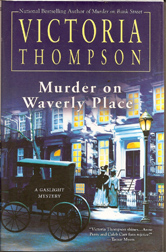 Murder
on Waverly Place (2009) opens with Brandt's mother asking her to join
her at a séance where she hopes to speak to Brandt's dead sister. Although
Brandt is unconvinced, her mother returns and is present when one of the
medium's clients is murdered while supposedly everyone in the room was seated
and holding hands. The dead woman - stabbed in the back - turns out to be the
owner of the house and patron of the medium. There is also a young man on the
premises who is coy about answering questions and who is undoubtedly responsible
for some of the special effects. Malloy discovers that a number of people
present had good reasons for wanting the victim dead. Although readable as
always, this one isn't as good as the rest. The action is quite static and the
solution comes in large part because of a rather large coincidence - one of the
recurring characters recognizes the killer as someone she met in the past.
There's some nice misdirection with a dead body, but it's not enough to carry
the whole story.
Murder
on Waverly Place (2009) opens with Brandt's mother asking her to join
her at a séance where she hopes to speak to Brandt's dead sister. Although
Brandt is unconvinced, her mother returns and is present when one of the
medium's clients is murdered while supposedly everyone in the room was seated
and holding hands. The dead woman - stabbed in the back - turns out to be the
owner of the house and patron of the medium. There is also a young man on the
premises who is coy about answering questions and who is undoubtedly responsible
for some of the special effects. Malloy discovers that a number of people
present had good reasons for wanting the victim dead. Although readable as
always, this one isn't as good as the rest. The action is quite static and the
solution comes in large part because of a rather large coincidence - one of the
recurring characters recognizes the killer as someone she met in the past.
There's some nice misdirection with a dead body, but it's not enough to carry
the whole story.
 Murder
on Lexington Avenue (2010) returns to the author's usual form and has an
interesting subplot about the rivalry between those who believed that the deaf
should learn to lip read and those who preferred signing. Some of the rationale
in both cases is bizarre, but some is quite interesting. Malloy decides to
investigate the murder of a prominent businessman even though he has no
authority in the case, primarily because the dead man has a deaf child, as does
Malloy. There are far too many suspects - from his family, the school, and his
business life, and when his pregnant widow goes into labor, it's obvious that
Brandt will be drawn into the case as well. Perhaps more than ever before, he is
forced to rely on her access to the upper classes of New York and her ability to
ask questions where he is shut out. The mystery element is quite well done and
the backdrop in this case was almost as interesting. Thompson continues to use
actual detection to solve the mystery rather than happenstance or coincidence,
without becoming so focused on that that she forgets to develop her characters.
Murder
on Lexington Avenue (2010) returns to the author's usual form and has an
interesting subplot about the rivalry between those who believed that the deaf
should learn to lip read and those who preferred signing. Some of the rationale
in both cases is bizarre, but some is quite interesting. Malloy decides to
investigate the murder of a prominent businessman even though he has no
authority in the case, primarily because the dead man has a deaf child, as does
Malloy. There are far too many suspects - from his family, the school, and his
business life, and when his pregnant widow goes into labor, it's obvious that
Brandt will be drawn into the case as well. Perhaps more than ever before, he is
forced to rely on her access to the upper classes of New York and her ability to
ask questions where he is shut out. The mystery element is quite well done and
the backdrop in this case was almost as interesting. Thompson continues to use
actual detection to solve the mystery rather than happenstance or coincidence,
without becoming so focused on that that she forgets to develop her characters.
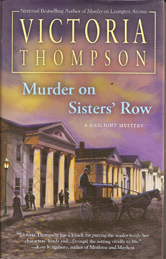 Murder
on Sisters' Row (2011) opens with Brandt summoned to deliver a baby at a
brothel, although she doesn't recognize what it is initially. Then she learns
that her patient is being held there against her will and, horrified, she
consults Malloy, who tells her that this is a dangerous criminal element and she
should steer clear of them. She tries to get help through an agency that
supposedly rescues involuntary prostitutes, but it's obvious early on that there
is something wrong with the agency. The rescue goes as planned but the aftermath
not so much. Amy, the supposed ex-prostitute, expects to be waited on. The
brother owner demands that the police return her "property" and the job is given
to Malloy. It also appears, however, that Amy was not a prostitute - though she
was destined to be - and was brought to the brothel for safekeeping by the
father of the baby, whom she calls Gregory. Not quite coincidentally, the woman
who runs the rescue operation is married to someone named Gregory, and within a
few days she turns up dead, poisoned, shortly after visiting the secret location
where the rescued women are kept. The dead woman's assistant immediately
switches from drab to fancy clothing and Amy and her baby disappear from the
shelter. The assistant was a former prostitute and her relations with the new
widower are questionable. Amy is kidnapped by the brothel owner, supposedly per
the widower's instructions, but the note was forged. Although this is fairly
good, the ending cheats considerably. A crucial piece of information is not
revealed until veary late and Brandt stumbles upon the identity of the murderer
only by finding herself nominated to be the next victim.
Murder
on Sisters' Row (2011) opens with Brandt summoned to deliver a baby at a
brothel, although she doesn't recognize what it is initially. Then she learns
that her patient is being held there against her will and, horrified, she
consults Malloy, who tells her that this is a dangerous criminal element and she
should steer clear of them. She tries to get help through an agency that
supposedly rescues involuntary prostitutes, but it's obvious early on that there
is something wrong with the agency. The rescue goes as planned but the aftermath
not so much. Amy, the supposed ex-prostitute, expects to be waited on. The
brother owner demands that the police return her "property" and the job is given
to Malloy. It also appears, however, that Amy was not a prostitute - though she
was destined to be - and was brought to the brothel for safekeeping by the
father of the baby, whom she calls Gregory. Not quite coincidentally, the woman
who runs the rescue operation is married to someone named Gregory, and within a
few days she turns up dead, poisoned, shortly after visiting the secret location
where the rescued women are kept. The dead woman's assistant immediately
switches from drab to fancy clothing and Amy and her baby disappear from the
shelter. The assistant was a former prostitute and her relations with the new
widower are questionable. Amy is kidnapped by the brothel owner, supposedly per
the widower's instructions, but the note was forged. Although this is fairly
good, the ending cheats considerably. A crucial piece of information is not
revealed until veary late and Brandt stumbles upon the identity of the murderer
only by finding herself nominated to be the next victim.
 Murder
on Fifth Avenue (2012) takes a new tack. Brandt's disapproving father is
shocked when one of the members of his club is found dead, apparently having
been stabbed so subtly that he didn't notice it until internal bleeding rendered
him unconscious. He reluctantly requests that Malloy investigate quietly since
he knows the man's discretion. Neither the dead man's wife, son, nor daughter in
law appear to be heartbroken. He also has a mistress and his valet indicates
that he had a meeting that morning with a mysterious Italian. The Italian turns
out to be a thug that the dead man's real estate firm uses to evict people and
they express surprise that the two were even acquainted. The daughter-in-law
wanted a divorce, the wife hated him, and the son is apparently gay, although
his wife has somehow managed to get pregnant, a fact she is concealing from the
family. The Italian tells Malloy that he was hired to have a woman killed but
that he had met her and refused to go through with it. The woman, Mrs. Richmond,
turns out to be the mother of the dead man's wife. Malloy concludes that the
marriage was arranged to mask the son's homosexuality and that for some reason
the mother was considered a threat, although she has no idea what the nature of
that threat might be.
Murder
on Fifth Avenue (2012) takes a new tack. Brandt's disapproving father is
shocked when one of the members of his club is found dead, apparently having
been stabbed so subtly that he didn't notice it until internal bleeding rendered
him unconscious. He reluctantly requests that Malloy investigate quietly since
he knows the man's discretion. Neither the dead man's wife, son, nor daughter in
law appear to be heartbroken. He also has a mistress and his valet indicates
that he had a meeting that morning with a mysterious Italian. The Italian turns
out to be a thug that the dead man's real estate firm uses to evict people and
they express surprise that the two were even acquainted. The daughter-in-law
wanted a divorce, the wife hated him, and the son is apparently gay, although
his wife has somehow managed to get pregnant, a fact she is concealing from the
family. The Italian tells Malloy that he was hired to have a woman killed but
that he had met her and refused to go through with it. The woman, Mrs. Richmond,
turns out to be the mother of the dead man's wife. Malloy concludes that the
marriage was arranged to mask the son's homosexuality and that for some reason
the mother was considered a threat, although she has no idea what the nature of
that threat might be.
One puzzling aspect of the case is that none of the clothing is damaged so it
appears that the man was stabbed while naked. This suggests the mistress, but
that seems likely, or the wife and/or son, who were present when he was briefly
naked on the morning when he died. Both of them had been arguing with him at the
time. For lack of another male character, it seems likely that the father of the
unborn child is the father and not the son. When the valet is poisoned and dies,
it seems pretty clear that someone at the house is responsible. Although it was
fairly easy to guess the right solution, others were possible and there are a
few minor surprises in the unraveling.
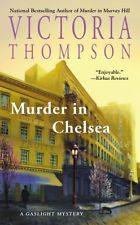 Murder
in Chelsea (2013) focuses on another of the ongoing subplots. A woman
turns up who claims to be working on behalf of the real mother of the girl
Brandt now considers her own daughter. Before she can learn more, the woman is
murdered, but Brandt enlists Malloy's help in looking into the case because she
wants to know the truth about Catherine's past. According to the woman's story,
Catherine and her mother were in danger because they had been named in a will.
They split up for safety's sake and through mischance the young girl was left
alone. Brandt isn't sure how much of this story is true and Malloy finds the
body when he starts his investigation. Through some letters found in the dead
woman's room, Malloy traces a man named Wilbanks who says that Catherine is his
daughter by way of Emma, his mistress. Wilbanks himself is dying of cancer. When
his wife died, Wilbanks had proposed to Emma but had been turned down. Wilbanks
also has a son and a daughter-in-law who are not happy with the idea of not
inheriting the full estate. There is also a daughter, but she has already
received her part of his estate as a dowry. The mother, an actress, is nowhere
to be found, and it appears in addition to being a wealthy man's mistress she
also has a boyfriend on the side.
Murder
in Chelsea (2013) focuses on another of the ongoing subplots. A woman
turns up who claims to be working on behalf of the real mother of the girl
Brandt now considers her own daughter. Before she can learn more, the woman is
murdered, but Brandt enlists Malloy's help in looking into the case because she
wants to know the truth about Catherine's past. According to the woman's story,
Catherine and her mother were in danger because they had been named in a will.
They split up for safety's sake and through mischance the young girl was left
alone. Brandt isn't sure how much of this story is true and Malloy finds the
body when he starts his investigation. Through some letters found in the dead
woman's room, Malloy traces a man named Wilbanks who says that Catherine is his
daughter by way of Emma, his mistress. Wilbanks himself is dying of cancer. When
his wife died, Wilbanks had proposed to Emma but had been turned down. Wilbanks
also has a son and a daughter-in-law who are not happy with the idea of not
inheriting the full estate. There is also a daughter, but she has already
received her part of his estate as a dowry. The mother, an actress, is nowhere
to be found, and it appears in addition to being a wealthy man's mistress she
also has a boyfriend on the side.
The investigation turns up contradictions in the statements of almost everyone
concerned. It is clear that Wilbanks' son-in-law is more involved and was
involved earlier than he is admitting. His daughter-in-law also uncovered the
existence of the mistress very early on. The mistress then announces that she is
going to marry Wilbanks after all, but it seems an idle threat as he is no
longer interested, and probably knows she has only said so as part of her plan
to extort money. There is also a cousin named Udall involved and he appears to
be in love with the daughter-in-law. Malloy decides to arrest Emma, Catherine's
actress mother, but finds her strangled on the floor in her boyfriend's hotel
room. The boyfriend is lying on the bed drunk. This comes as no surprise since
we know that Catherine is going to stay with Brandt, and with her father dying
the outcome seems obvious. There is also good reason to believe that the first
murder was committed by a woman, and the rapacious daughter-in-law seems the
most likely candidate, with her secret love Udall as the probably killer in the
second instance. The resolution is well handled even though it was obvious who
was responsible, but there's a nice twist at the end with the dying man leaving
most of his fortune to Malloy so that he can look after Catherine properly,
which leads logically to his proposal to Brandt and her acceptance.
 Murder
in Murray Hill (2014) is, as of this writing, the most recent novel in
the series. Malloy, on what might be his last case, is investigating the
disappearance of a young woman who may have been led astray by a con man using
the lonely hearts column. Unfortunately news of his sudden rise to riches
results in his being dismissed from the force and he fears that no one will do
anything further despite the clues he has unearthed toward discovering the
identity of the con man. Despite this, he follows through with a plan to lure
the man out, and eventually finds him lying dead in his house, along with the
missing woman, another locked in a cage, and evidence that there have been a
dozen or so earlier victims. Although the missing girl is found in the same room
as the dead man, the lack of a murder weapon suggests that she didn't actually
kill him. Associated with the man is a friend who lives nearby with another of
the ruined girls, and a handyman who appears to have disappeared.
Murder
in Murray Hill (2014) is, as of this writing, the most recent novel in
the series. Malloy, on what might be his last case, is investigating the
disappearance of a young woman who may have been led astray by a con man using
the lonely hearts column. Unfortunately news of his sudden rise to riches
results in his being dismissed from the force and he fears that no one will do
anything further despite the clues he has unearthed toward discovering the
identity of the con man. Despite this, he follows through with a plan to lure
the man out, and eventually finds him lying dead in his house, along with the
missing woman, another locked in a cage, and evidence that there have been a
dozen or so earlier victims. Although the missing girl is found in the same room
as the dead man, the lack of a murder weapon suggests that she didn't actually
kill him. Associated with the man is a friend who lives nearby with another of
the ruined girls, and a handyman who appears to have disappeared.
The handyman is stabbed to death the following day when he returns to the house
and initiates a plan to blackmail some of the customers. There are strong clues
that the woman locked in the cage could have easily escaped and might in fact
have committed both murders. The solution is arrived at by both Malloy and
Brandt separately, but they have a problem. Although both cases were clearly
murder, they don't want the killer punished for destroying two monsters, nor do
they want to damage the reputations of the others who were imprisoned by them.
So they convince all of the suspects to confess individually, leaving the police
with no case to present. Another good novel with a reasonable amount of actual
detective work.